
Through history, the Mela has held different meanings for ascetics, the colonised, colonisers, and tourists, but all have been moved by its grandeur points out Atanu Biswas.

Sections of our media and elites take Western reports/judgements at face value and are ready to condemn the targets without understanding the deeper power linkages behind such actions, asserts Colonel Anil A Athale (Retd).

'While suppression of information is acceptable for the government, the Opposition's efforts at pinning the government and its leaders is labeled anti-national,' points out Nilanjan Mukhopadhyay.

'Retail investors have to stick to their asset allocation plans and continuously do portfolio reviews.'

The Indian markets have delivered high long-term returns, second only to the US.

Here is an explainer on the functioning of the seven-year-old body.


Is India headed there again? questions Ajit Balakrishnan

Analysts are warning of growing risks to the market's sustained momentum, and even to the possibility of consolidation at current levels. Domestically, markets are grappling with several challenges, including a slowing economy, as indicated by the latest GDP data for the July-September (Q2) quarter of 2024-25 (FY25), sticky inflation, fluctuations in the rupee, waning consumption, and high interest rates.

From the Sensex pack, Tech Mahindra, HDFC Bank, Larsen & Toubro, ITC, Infosys, IndusInd Bank, Kotak Mahindra Bank, Titan and HCL Technologies were among the gainers. Maruti Suzuki India, Tata Steel, Bajaj Finance, UltraTech Cement, Nestle India, Axis Bank and Tata Consultancy Services (TCS) were among the laggards.

'As the global economy undergoes significant transformations in 2025, India's ability to navigate the complexities of trade wars, financial realignments, and emerging blocs will be pivotal,' explain Harsh V Pant and Soumya Bhowmik.

'When compared to many of America's treaty allies in Asia, Modi 3.0 is on a much stronger footing.'

All sectoral indices ended lower. BSE Telecommunication tanked 2.18 per cent, metal (1.77 per cent), auto (1.70 per cent), energy (1.64 per cent), oil & gas (1.59 per cent), commodities (1.39 per cent) and financial services (1.37 per cent) were the major laggards.

Tata Steel, Bajaj Finance, Mahindra & Mahindra, JSW Steel, NTPC, Adani Ports, Bajaj Finserv and Larsen & Toubro were also among the laggards. However, Power Grid, HCL Technologies, Infosys, Tech Mahindra, Tata Consultancy Services and ICICI Bank were among the gainers.

Among the Sensex firms, Titan, Asian Paints, ITC, Hindustan Unilever, Nestle India, Bajaj Finserv and Bharti Airtel were among the gainers. In contrast, UltraTech Cement, Tech Mahindra, Tata Steel, Power Grid, HDFC Bank, HCL Technology, State Bank of India and ICICI Bank were the laggards.

IPOs worth Rs 50,000 crore including Hyundai, NTPC Green Energy and Swiggy are set to hit the market in late October or early November.

In the last budget, then finance minister Arun Jaitley had allocated Rs 85,010 crore for the education sector which was later revised to Rs 83,625.86 crore.

As Canadian Prime Minister Justin Trudeau testified before a Commission of Inquiry, the Ministry of External Affairs (MEA) on Thursday said what it has heard only 'confirms' New Delhi's consistent stand that Canada has 'presented us no evidence' in support of the serious allegations Ottawa chose to level against India and Indian diplomats.

'Indians are basically liked because they are educated, they are intelligent.'

Anticipating US action on tariffs, India seems to have made the first move by revamping its tariff structure by reducing the slabs to eight rates, points out Mukesh Butani.

India believes that Canada doesn't take seriously violence or terrorism or incitement to hatred seriously, Canadian Prime Minister Justin Trudeau said on Wednesday as he cited foundational responsibility for the Canadian government for not taking actions against those espousing violence and terrorism against a third country.

Bibek Debroy was one of the very few economists not bound by any single area of expertise and was simultaneously curious about economics and politics, myths and maths, chess and chemistry, and what not, remembers Laveesh Bhandari.

There is confusion around the registration guidelines and the cut-off dates for acquiring the degrees.

India's healthcare and pharmaceutical sectors raised Rs 14,811 crore through initial public offerings (IPOs) in 2024, the largest since 2019, driven by strong domestic demand amid expanding global opportunities. According to data, key contributors to the record fundraising included Sai Life Sciences (Rs 3,043 crore), IKS Health (Rs 2,498 crore), and Sagility India (Rs 2,107 crore).

Dalal Street minnows stole the show in 2024, giving handsome returns to investors, helped by a largely optimistic trend in the stock market and impressive retail investors' participation. Analysts attributed the positive trend in the equity markets, where the benchmark indices shattered many records this year, to robust domestic liquidity, strong fundamentals of the Indian economy, and policy continuity.

Institutional investments in real estate may fall 20 per cent to $4 billion during this calendar year because of a higher inflow of funds in 2020, according to property consultant JLL India. During the January-September period, the institutional investment rose to $2,977 million from $1,534 million in the year-ago period. "Unless some large portfolio deals are not inked at the end of the year, annual investments are expected to be in the $3.8-4 billion range in 2021," JLL said in a statement. Institutional investments managed to cross the $5 billion mark in 2020 due to large portfolio deals worth $3.2 billion during the last quarter of the year.

Global trends, trading activity of foreign investors and domestic macroeconomic data announcements would dictate terms in the equity market in a holiday-shortened week ahead, analysts said. Equity markets would remain closed on Wednesday for Gandhi Jayanti. "Looking ahead, it will be interesting to monitor Foreign Institutional Investors (FIIs) and their flow into India.

The US Federal Reserve's interest rate decision is the biggest event that would drive sentiments in the domestic stock market this week, besides a host of macroeconomic data from the global front and trading activity of foreign investors, analysts said. The Indian equity market had an exceptional last week, with both the Nifty and Sensex hitting their all-time high levels on Thursday.
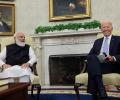
'The message that we intend to leave with at the end of this trip is one of real gratitude for the friendship and the close partnership that President Biden and Prime Minister Modi have enjoyed over the last four years, but also one of tremendous optimism because we see a lot of opportunity in the future.'

Market reaction to the Union Budget was overall neutral. The income tax "gift" wasn't enough to move the needle. There was some apparent rationalisation of Customs duty structure as well as cuts on import duties of some key components for the telecom and IT industry and duty cuts on vehicle imports. Other proposals related to development of agriculture and rural economy and renewables seem to be generally positive.

"The new structure will substantially reduce taxes on the middle class and leave more money in their hands, boosting household consumption, savings and investment," Sitharaman said presenting what was dubbed as 'reformist' budget for the next fiscal in Lok Sabha.

Out of 24,230 IIT and NIT grads, about 8,000 students didn't find any takers during campus placement drives this year.

The fund will promote domestic shipbuilding of all types and sizes to reduce India's dependence on foreign ships.

With its age-old fascination for education, southern states have done better than the North. Start-ups, IT hubs, and industry majors setting up shop have changed the face of the South. Nearly 79% of global offices set up by international conglomerates in India are in the South. Almost 46% of tech unicorns are from the South. The GDP per person in the South is 4.2 times higher than the North. None of these indicators can be ignored by any central government, whatever the political compulsions, notes Ramesh Menon.

Jaishankar said, "The immediate part which awaits us is what we call the de-escalation, which is the build-up of forces along the Line of Actual Control."

Quarterly earnings of corporates, trading activity of foreign investors and inflation data are the key factors that are expected to drive the momentum in the equity markets this week, analysts said.

Why can't the Indian government propose to the Chinese a corridor circumambulating the Holy Mountain where people from both sides could perform the yatra again? asks Claude Arpi.

The week's losses wiped out investor wealth worth Rs 18.43 trillion, with the total market capitalisation of BSE-listed firms now at Rs 441 trillion.

China and India were able to "reduce differences" and build "some consensus" on disengaging troops from friction points to end the standoff in eastern Ladakh and agreed to maintain dialogue to reach a resolution acceptable to both sides at an "early date", the Chinese defence ministry said on Thursday.

It's a strategic approach in which the country's military and defence mechanisms evolve continuously in tandem with emerging threats. The new strategy anticipates events and prepares to counter those proactively.
 © 2026 Rediff.com - Advertise with us - Disclaimer - Privacy Policy - Sitemap - Feedback - About us - Terms of use - Grievances